Follow my Facebook page Health Freak Mommy for more stories and videos π
Tuesday, March 17, 2026
Healthy, Crunchy & Perimenopause-Friendly: My Favourite Seed Snacks
Follow my Facebook page Health Freak Mommy for more stories and videos π
Wednesday, March 11, 2026
A Simple Food Day in Ipoh
Today, Mum and I made a quick trip to Beacon Mart in Ipoh Garden South to stock up on a few of our usual favourites. Into our basket went marinated chicken chops, saba fish, Beacon sprouted beans & gains bread, Beacon wantons, and Beacon chicken soup.
One reason we like buying chicken from Beacon is that their chickens are free from antibiotics and hormones, which makes them suitable for cancer patients and those who prefer cleaner, healthier food choices.
After grocery shopping, we headed nearby to look for lunch. I noticed an eatery named Cong Yin Noodles, and since the stall was set up outside the shop, I could clearly see the noodle seller preparing the noodles. The bowl looked very tempting, topped with big chunks of minced pork and pieces of dried bamboo fungus.
I ordered one packet with added pork slices to share with Mum. The noodles were comforting and flavourful, perfect for a simple lunch.
Later, Dad went out to tapau his favourite Nasi Kandar from Ipoh Garden East. When he came home, we were shocked at the size of the rice portion in the packet. It was huge — honestly enough to feed four small eaters!
Dad chose a big serving of turmeric cabbage and generously asked for kurma chicken gravy to banjir (flood) his rice. On top of that, he ordered a large fish head cooked with lady’s fingers.
The total bill? Only RM16 — RM12 for the huge fish head and RM4 for the packet of rice with cabbage. What a steal!
That’s one of the little perks of living in Ipoh. Food here is still so much cheaper compared to Kuala Lumpur.
The nasi kandar packet will easily last Dad for both lunch and dinner. Mum and I shared the noodles earlier, and tonight Dad will air-fry the saba fish we bought from Beacon Mart.
Simple, everyday food for the three of us.
Nothing fancy — but honestly, that’s perfectly okay. π½️π
| Dad's nasi banjir with turmeric cabbage and chicken kurma sauce and a huge fish head curry. |
| Beacon wanton, Beacon seaweed chicken soup, frozen saba fish and Beacon sprouted beans & grains bread. |
Famous Pau in Bercham - A Visit to Restoran Loke Yuen
It’s a Saturday morning in Bercham, and we stopped by a humble coffee shop that many locals swear by for their pau.
Restoran Loke Yuen may look unassuming, but by 11:30am there was already a long queue for their famous steamed paus.
The coffee shop sits on the same row as the well-known K10 Claypot Chicken Rice.
While waiting, we also tapau some yong tau fu and stuffed “liu” from the stall next door.
From the pau stall, we managed to grab a few char siu paus, ma lai ko, and black sesame mantou — the other fillings were already sold out.
First impression?
The pau skin was soft, fluffy, and pillowy — not soggy or starchy.
The char siu filling was flavorful without being overly salty or sweet, and thankfully there was no strong ammonia smell.
At RM4 each, the char siu pau isn’t cheap — but it’s definitely delicious.
The ma lai ko was also wonderfully soft and worth getting again.
As for the yong tau fu — it’s the solid tofu type, while we personally prefer the softer version. The fried savory turnip cakes were quite good though, and the other stuffed “liu” were decent.
Next time we’re craving char siu pau again, this little coffee shop in Bercham will definitely be our go-to place to stock up.
Address
Restoran Loke Yuen
632, Lorong Bercham 6, Kampung Bercham,
31400 Ipoh, Perak
You can watch the video here - https://www.youtube.com/shorts/uTLZQPu9XRk
Thursday, March 5, 2026
Walking the Health Tightrope - PCOS, Pre-Diabetes and the Challenge of Healthy Weight Gain
Yesterday I went to Pantai Hospital Ipoh to review my medical report with the family physician at the Health Screening Department.
Besides one issue that needs yearly (or even bi-annual) monitoring, the doctor pointed out something else — I am underweight. At 41kg, she advised me to put on a little weight to reduce the risk of low bone mass. Osteoporosis is more common in thinner individuals due to lower peak bone mass and decreased mechanical loading on the skeleton. Prevention, she emphasized, is key.
She encouraged me to continue my brisk walking and to incorporate weight lifting and squats. I smiled quietly because between daily house chores and my regular workouts, I already do plenty of squats! She also advised me to drink milk daily — which I am already doing.
Then came the more complicated part.
My fasting blood sugar was 4.9 mmol/L — comfortably within range. However, my HbA1c crept up to 6.0, which falls into the pre-diabetic range. As someone with PCOS — an insulin-resistance disorder — I already carry a higher risk of developing Type 2 diabetes.
Last year, my KL gynae suggested starting metformin if I wanted to continue enjoying sweet treats for “a sweeter life.” I chose instead to cut down further on sugary foods. My HbA1c improved to 5.8 — better, but still not ideal. I would like it to be at 5.7 or lower.
If I’m honest, the recent spike may have been self-inflicted — thanks to Chinese New Year cookies, bak kwa and festive goodies. Indulgence has consequences.
So here I am, standing at a nutritional crossroads.
On one hand, I need to gain a little weight to protect my bones.
On the other hand, I need to cut down further on carbohydrates to protect my pancreas.
More than two decades ago, when I was first diagnosed with PCOS, I stopped eating rice, noodles, and significantly reduced white flour products (though not completely eliminating them). With age catching up, perhaps I need to tighten the discipline even more — or consider medication if lifestyle measures are no longer enough.
For now, I will:
Increase the intensity and duration of my brisk walks
Add more structured weight training
Cut back further on sweet foods (even fruits) - which is very hard as I am already controlling my sugary foods now.
Repeat my blood test in three months
Health, it seems, is always about balance — sometimes a delicate and frustrating one.
But I am determined to keep walking this tightrope carefully.
So what can I eat now if I have to cut back on fruits, biscuits, breads and cakes for breakfast and snacks?
The answer seems to be: more nuts!
I already eat walnuts, chia seeds and ground flaxseeds daily, but now it looks like I need to stock up on an even wider variety of nuts and seeds.
Last night at 9:30 pm, I ordered a 1kg pack of groundnuts from Shopee. To my surprise, the parcel was delivered this morning at 9 am! I must say I am very impressed with how fast the seller and Shopee managed the delivery.
Next on my list: pumpkin seeds and sunflower seeds to add to my growing stash of healthy snacks.
Looks like my snack drawer is about to become a nut-and-seed bar. π
Rhodiola vs Ashwagandha: How to Choose the Right Adaptogen for Stress, Energy, and Sleep
Rhodiola vs ashwagandha is one of the most practical supplement comparisons because these two “adaptogens” often get recommended for the same modern problems: stress, fatigue, low motivation, and poor sleep. But they do not feel the same, and they do not fit the same person.
In this guide, I’ll compare what the research actually supports, what product labels don’t tell you, and how to choose without hype. This is educational information, not a diagnosis or medical advice.
What’s the simplest difference between rhodiola and ashwagandha?
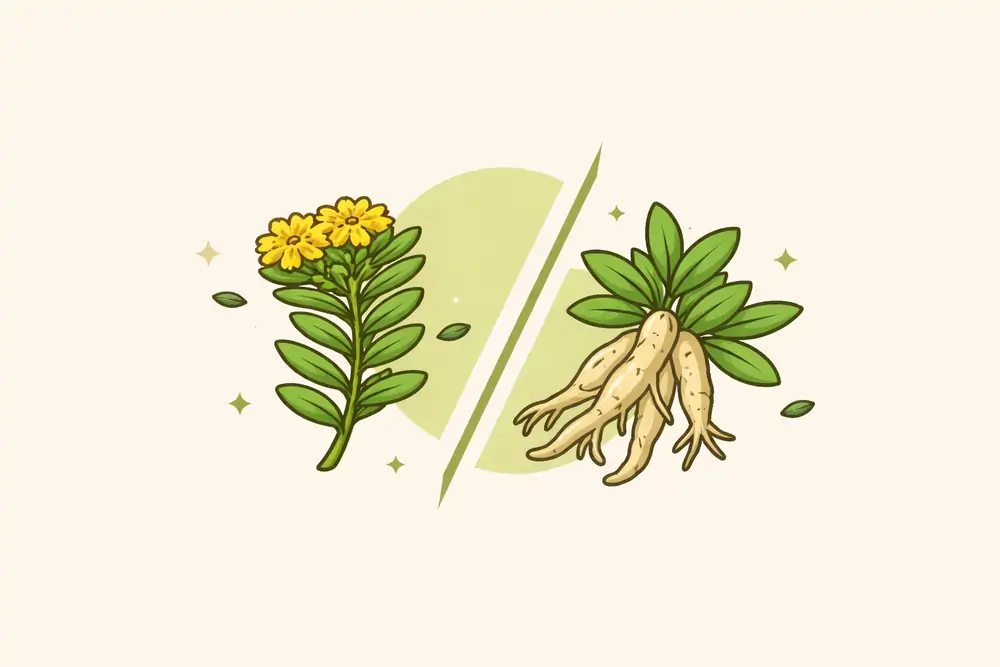
If you want the short version: rhodiola tends to be used for daytime “mental stamina” and perceived fatigue, while ashwagandha is more often used for calming, stress tension, and sleep support. That’s not a rule, but it matches how many people report the experience and how the clinical research clusters.
Both are discussed as adaptogens, yet “adaptogen” is a broad traditional concept. In modern research, the relevant question is narrower: which one has better human evidence for your main goal and better safety for your situation?
What are these herbs, exactly?
Rhodiola (Rhodiola rosea)
Rhodiola rosea is a cold-climate plant sometimes called “arctic root.” Most standardized supplements use the rhizome and root. Quality products often specify marker compounds such as rosavins and salidroside, because the Rhodiola genus has many species and not all match the research.
Ashwagandha (Withania somnifera)
Ashwagandha is an Ayurvedic herb also known as “winter cherry”. Supplements typically use root extract (sometimes root + leaf). Labels may mention withanolides as markers, but “withanolides %” alone does not guarantee clinical equivalence across brands.
What does the evidence say for stress and anxiety symptoms?
If your primary goal is stress tension or anxious feelings (not a medical diagnosis), ashwagandha has the more consistent human evidence. A 2024 meta-analysis (9 studies, 558 participants) reported statistically significant improvements in stress and anxiety measures and reductions in cortisol compared with placebo in the studied populations.
Rhodiola also appears in stress-related research, including regulatory monographs in Europe that recognize traditional use for stress-related fatigue and exhaustion. But overall, rhodiola studies often emphasize fatigue, cognitive performance under stress, and physical performance markers more than “calming.”
In a 2024 meta-analysis, ashwagandha showed significant improvements in perceived stress and anxiety outcomes across 9 trials (total N=558), with studied doses commonly in the 125–600 mg/day range for 30–90 days.
European regulators describe rhodiola root/rhizome preparations as a traditional herbal option for relief of stress symptoms such as fatigue and exhaustion (traditional use framework).
What does the evidence say for energy, fatigue, and performance?
If you’re comparing rhodiola vs ashwagandha for “energy,” define what you mean. Most people mean one of two things: (1) less perceived fatigue and more mental drive, or (2) better physical performance.
Rhodiola has newer meta-analytic work looking at performance outcomes and biomarkers in endurance contexts. That doesn’t mean it “boosts everyone,” but it shows why rhodiola is often positioned as the “daytime adaptogen.”
Ashwagandha is also studied for strength, recovery, and well-being, but its mainstream reputation is still more “calm + sleep.” If you’re already low-energy and stressed, the calming feel may help some people sleep better, which indirectly helps daytime function.
A 2025 meta-analysis evaluated randomized trials of Rhodiola rosea supplementation on endurance performance and physiological biomarkers, synthesizing evidence up to March 2025.
How do they work in the body (without overpromising)?
Mechanisms are not guarantees. Still, understanding the “direction” helps you choose.
Rhodiola: stress response + fatigue perception
Rhodiola research often discusses stress-response pathways, perceived exertion, and neurochemical signaling under strain. In practice, people usually take rhodiola earlier in the day because it can feel activating for some.
Ashwagandha: stress tension + sleep quality signals
Ashwagandha studies commonly measure stress scales and cortisol, and some trials measure sleep quality. Many users prefer evening dosing because it may feel settling. However, responses vary and some people feel groggy with higher doses.
Which one should a beginner choose?
Make the choice based on your primary use case, then confirm it with safety fit.
| Your main goal | Often a better first pick | Why | Common timing |
|---|---|---|---|
| Daytime fatigue, mental stamina, “burnout” feeling | Rhodiola | Traditional-use framework for stress fatigue; performance/fatigue research cluster | Morning / early afternoon |
| Stress tension, feeling “wired,” difficulty winding down | Ashwagandha | More consistent RCT/meta-analysis evidence for stress/anxiety symptoms | Evening or split dose |
| Sleep support (without making medical claims) | Ashwagandha | More trials include sleep-related outcomes | Evening |
| Performance-focused training block | It depends | Rhodiola has endurance-focused synthesis; ashwagandha has strength/well-being reviews | Goal-dependent |
What dose ranges show up most in research?
Don’t treat dose ranges like prescriptions. Use them to avoid unrealistic dosing and to spot products that look underdosed or overdosed.
Ashwagandha typical studied range
Many stress-focused trials use standardized extracts in the rough range of 125–600 mg/day for 30–90 days. Extract type matters, so compare “extract name/standardization,” not just milligrams.
Rhodiola typical studied range
Rhodiola trials vary widely by extract and outcome. Regulatory documents emphasize standardized preparations and appropriate product quality, and research often uses standardized extracts rather than raw powder.
Practical tip: for both herbs, a “start low, assess for a week, then adjust” approach is smarter than jumping to the highest capsule count.
What about side effects and interactions?
This is where rhodiola vs ashwagandha becomes very personal. “Natural” does not mean “interaction-free.”
Ashwagandha: key cautions
- Thyroid: Some reports and clinical discussions suggest possible thyroid hormone effects in certain people. If you have thyroid disease or take thyroid meds, be cautious.
- Pregnancy: Avoid unless a clinician explicitly advises otherwise.
- Sedatives / alcohol: May increase drowsiness in some people.
- GI effects: Upset stomach, nausea, or loose stools can happen.
- Liver concerns: There have been safety discussions and case reports in the broader literature; use reputable brands and stop if you develop symptoms like dark urine or jaundice and seek medical care.
Rhodiola: key cautions
- Too stimulating for some: Can feel jittery or disturb sleep if taken late.
- Medication interactions: If you take antidepressants or have bipolar disorder history, talk to a clinician first due to mood/activation concerns.
- GI effects: Nausea or stomach upset can occur.
If you are on prescription meds, pregnant, breastfeeding, or managing a chronic condition, check with a qualified clinician before starting either supplement.
How to pick a high-quality product
Two people can take “ashwagandha” and have totally different experiences because the products are not equivalent.
For rhodiola
- Look for Rhodiola rosea (not just “Rhodiola spp.”).
- Prefer labels that specify markers like rosavins and salidroside and disclose extract ratio.
- Choose brands with contaminant testing (heavy metals, microbes).
For ashwagandha
- Check whether it is root-only or root + leaf, and whether the extract is standardized.
- Prefer clear marker disclosure (withanolides) plus third-party testing.
- Be skeptical of extreme claims on labels or ads.
Checklist: a fast decision method
- Name one goal. “Less stress tension,” “better sleep,” or “less daytime fatigue.” Pick only one.
- Match herb to goal. Stress/sleep → often ashwagandha. Fatigue/drive → often rhodiola.
- Scan your risk flags. Thyroid issues, pregnancy, sedatives, mood disorder history, complex meds.
- Pick a standardized product. Clear markers + third-party testing beats vague labels.
- Start low and track. Sleep, energy, mood, GI comfort for 7–14 days.
- Stop if you get adverse effects. Don’t “push through” palpitations, severe anxiety, rash, or persistent GI issues.
Can you take rhodiola and ashwagandha together?
Some people combine them (rhodiola in the morning, ashwagandha in the evening). Conceptually, it’s a “day-night” stack. But stacking also stacks uncertainty: interactions, additive effects on mood/sedation, and product variability.
If you’re a beginner, I’d rather see you test one at a time for 2–3 weeks. That’s how you learn what actually works for you.
Where expectations go wrong
Most disappointment comes from one of these:
- Using the wrong tool: expecting rhodiola to fix insomnia or ashwagandha to create instant motivation.
- Undersleeping: no supplement replaces sleep debt.
- Overpromised outcomes: “adaptogens” support coping; they are not cures.
- Low-quality products: wrong species, low standardization, poor testing.
Rhodiola vs Ashwagandha | FAQ
Which is better for stress: rhodiola vs ashwagandha?
Ashwagandha has more consistent clinical evidence for stress and anxiety symptom measures in adults.
Which is better for energy and fatigue?
Rhodiola is more often used for perceived fatigue and daytime stamina; responses vary by person and product.
Can ashwagandha make you sleepy?
Yes. Some people feel more relaxed or drowsy, especially with higher doses or evening use.
Can rhodiola make you anxious?
It can feel stimulating for some people, especially if taken too late or at higher doses.
How long does it take to notice effects?
Many trials run 30–90 days for ashwagandha. For rhodiola, some people notice effects sooner, but research varies by outcome and extract.
Who should avoid these supplements?
Pregnant people, minors, and anyone with complex medical conditions or prescription medications should speak with a clinician first.
Glossary
- Rhodiola rosea: The studied rhodiola species most commonly used in supplements.
- Withania somnifera: The botanical name for ashwagandha (winter cherry).
- Adaptogen: A traditional term for herbs used to support stress resilience; not a guarantee of a specific medical outcome.
- Rosavins: Marker compounds often used to standardize Rhodiola rosea extracts.
- Salidroside: Another key rhodiola marker used in research and quality control.
- Withanolides: A class of compounds used to characterize ashwagandha extracts.
- Standardized extract: An extract adjusted to contain a consistent level of marker compounds.
- Third-party testing: Independent testing for identity and contaminants (e.g., heavy metals, microbes).
Conclusion
If you want calmer evenings and better stress balance, start with ashwagandha. If you want more daytime stamina under pressure, start with rhodiola—then let your tracking decide.
Sources used
- NIH Office of Dietary Supplements (ODS). “Ashwagandha—Health Professional Fact Sheet” (updated May 2, 2025). [oai_citation:0‡Office of Dietary Supplements](https://ods.od.nih.gov/factsheets/Ashwagandha-HealthProfessional/?utm_source=chatgpt.com)
- Arumugam V. et al. Systematic review/meta-analysis on ashwagandha effects on stress, anxiety, and cortisol (2024; 9 studies, 558 participants; doses commonly 125–600 mg/day for 30–90 days). [oai_citation:1‡ScienceDirect](https://www.sciencedirect.com/science/article/abs/pii/S1550830724001691?utm_source=chatgpt.com)
- European Medicines Agency (EMA), HMPC. EU herbal monograph: Rhodiola rosea L., rhizoma et radix (revision dated March 20, 2024) describing traditional use for stress symptoms such as fatigue/exhaustion. [oai_citation:2‡European Medicines Agency (EMA)](https://www.ema.europa.eu/en/documents/herbal-monograph/final-european-union-herbal-monograph-rhodiola-rosea-l-rhizoma-et-radix-revision-1_en.pdf?utm_source=chatgpt.com)
- EMA. “Rhodiolae roseae rhizoma et radix” overview page summarizing HMPC conclusions used by EU member states when evaluating herbal medicines. [oai_citation:3‡European Medicines Agency (EMA)](https://www.ema.europa.eu/en/medicines/herbal/rhodiolae-roseae-rhizoma-et-radix?utm_source=chatgpt.com)
- TΓ³th-MΓ©szΓ‘ros A. et al. Systematic review and meta-analysis on adaptogenic plants and stress outcomes (2023). [oai_citation:4‡ScienceDirect](https://www.sciencedirect.com/science/article/pii/S1756464623002955?utm_source=chatgpt.com)
- Wang X. et al. Meta-analysis on Rhodiola rosea supplementation and endurance performance/biomarkers (2025). [oai_citation:5‡PMC](https://pmc.ncbi.nlm.nih.gov/articles/PMC12507841/?utm_source=chatgpt.com)
- Health Canada. “Natural Health Product Monograph: Rhodiola—Rhodiola rosea” (Oct 31, 2025) providing regulatory-style guidance on acceptable labeling and conditions for product licensing. [oai_citation:6‡webprod.hc-sc.gc.ca](https://webprod.hc-sc.gc.ca/nhpid-bdipsn/dbImages/mono_rhodiola--rhodiola-rosea_english.pdf?utm_source=chatgpt.com)
- EMA. Withaniae somniferae radix (ashwagandha) herbal product page noting no adopted EU herbal monograph by HMPC (public info). [oai_citation:7‡European Medicines Agency (EMA)](https://www.ema.europa.eu/en/medicines/herbal/withaniae-somniferae-radix?utm_source=chatgpt.com)
- EMA. “List of references supporting the assessment of Withania somnifera (L.) Dunal, radix” (2013). [oai_citation:8‡European Medicines Agency (EMA)](https://www.ema.europa.eu/en/documents/herbal-references/final-list-references-supporting-assessment-withania-somnifera-l-dunal-radix-first-version_en.pdf?utm_source=chatgpt.com)
Monday, March 2, 2026
The Fibroid That Came Back: A Story of Fear, Faith, and Letting Go
Shortly after I gave birth to Cass, my youngest girl — sometime in 2008 or 2009 — my gynaecologist spotted a very tiny fibroid during a routine ultrasound scan. I can’t remember the exact year, but I remember his words clearly.
“It’s very small. Just monitor it.”
So I did.
In the early years, it caused no trouble at all. No pain, no heavy bleeding, nothing alarming. Life went on as usual, and that tiny fibroid faded into the background of my busy days as a mum.
But around 2015, things started to change.
My periods became unbearably heavy. Not the normal kind of heavy — the kind that makes you tired, woozy and very uncomfortable. This was extreme. I had to wear diapers (changed every hourly) during my period just to get through the day. It was physically draining and emotionally exhausting.
After consulting several doctors, I finally decided to go for a laparoscopic myomectomy in 2017. It’s a minimally invasive surgery commonly preferred over open surgery for removing uterine fibroids. Smaller cuts, faster recovery, less trauma to the body.
But what happened before the surgery was the scariest part.
The month leading up to it, I nearly bled to death during my period. My red blood cell count dropped dangerously low. My gynae warned me that if my levels didn’t improve, I might need a blood transfusion during surgery.
That possibility terrified me.
I was prescribed Sangobion iron supplements twice a day to boost my iron levels. I also drank red and black dates water daily and forced myself to eat more red meat. I did everything I could to build my blood back up.
On the day of my surgery, they repeated my blood test.
My red blood cell count had improved.
No transfusion needed.
I was incredibly relieved. The surgery went smoothly, and I was discharged less than 24 hours later. I still remember how thankful I felt — thankful to have gone through it safely, thankful that my body pulled through.
For a few years after that, life returned to normal.
Then, about four or five years later — sometime in 2021 or 2022 — during my annual checkup, my gynae found another fibroid.
My heart sank instantly.
All the old fears came rushing back. The bleeding, the weakness, the anxiety, the surgery. I remember thinking to myself: should I have asked for a hysterectomy back in 2017? Would that have spared me from going through this again?
Since discovering this new fibroid, I’ve been praying quietly every year that it would stop growing… or even disappear miraculously. Each annual scan feels like waiting for exam results.
The good news? It’s growing very slowly. From last year to this year, there has been little to no change in size. That alone gives me some comfort.
Over the years, I’ve reflected a lot on why this happened. I truly believe that prolonged stress, lack of sleep, and emotional struggles played a role. My acupuncturist once told me that in Traditional Chinese Medicine, fibroids are often linked to trapped negative emotions — especially stress and anger. From a medical standpoint, hormones like estrogen are also known contributors.
Maybe the truth lies somewhere in between.
At this stage, there isn’t much I can do except continue monitoring it. I also have a tiny ovarian cyst that’s being watched. I’m hoping that menopause will arrive soon and naturally slow down or stop these growths altogether.
My mum once shared that she has had an ovarian cyst for many years, and her doctor told her it didn’t need to be removed. That gave me some reassurance. Sometimes, not everything inside us needs to be “fixed.” Some things just need watching and patience.
The photo here was taken in May 2017, nine years ago, after my fibroid removal surgery at Sunway Medical Centre.
Today, I still hope I won’t need another surgery. But if it ever becomes necessary to save my life, I know I will face it the same way I did before — with fear, yes, but also with faith.
Because life has taught me this: we don’t always get control, but we always get a choice in how we face what comes next.
| Less than 24 hours after my surgery with dad, mum, Sherilyn (12yo) & Cass (9yo). |
| My abdomen looks awful with scars from 3 C-sections, an ovarian drilling surgery (part of my fertility treatment as I had PCOS), and a fibroid removal surgery. |
From Jigsaw Floors to Rubik’s Cubes: A Little Throwback to 2016
While scrolling through my Google Photos today, I stumbled upon a photo of Cass taken in February 2016. She was holding a Rubik’s cube, completely absorbed in it — and just like that, a flood of memories came rushing back.
Back then, both Alycia and Cass were crazy over the Rubik’s cube. Alycia’s high school teacher had encouraged the class to solve it during breaks, and she quickly got the hang of it. Within a short time, she could solve the entire cube in just a few minutes. Naturally, curious little Cass followed along. She was fascinated watching her sister and soon wanted one of her own.
From that point on, the cube went everywhere with her — waiting for me outside fitting rooms, sitting on trains, in the car, basically wherever we went. And somehow, she eventually mastered it too. She has always had a special gift for puzzles.
Even as a toddler, Cass was obsessed with jigsaw puzzles. At just two years old, she would sit on the floor completely immersed, piecing everything together with intense focus. I still remember moments when everyone was ready to head out, yet she remained glued to the floor, determined to finish her puzzle first.
Looking back at that photo, I realise how quickly time has flown. I miss that little puzzle-obsessed baby so much. Counting down the days — I’ll be seeing her again at the end of this month ❤️
Forex Has Become A Sophisticated Side Hustle For Stay-At-Home-Moms
If you're a stay-at-home mom, you know that, in this economy, surviving on one household income is extremely difficult. But that doesn't mean you need to give up your SAHM dreams and go back to work; you can start trading forex from home to help boost your household income.
Being a SAHM has changed dramatically over the years. As women have become more and more independent, the things you can do to keep yourself entertained or help supplement the household income have also become a lot more sophisticated. You don't need to throw Tupperware parties anymore or go door-to-door through your neighbourhood selling beauty products. These days, thanks to the internet, you can find so many rewarding ways to make money online.
You may have seen somewhere on the news forex trading has become a more mainstream income source than before. Most people wouldn't think twice about this because they're so accustomed to trading being something reserved for economists, but that's no longer true. Actually, with the right tools and resources, almost anyone can start forex trading, even a SAHM.
What Is Forex Trading?
Forex trading, also known as foreign exchange (FX), refers to the decentralized global market for buying and selling currencies with the aim of profiting from their price fluctuations. It's actually the largest financial market in the world, with a daily volume that exceeds $7.5 trillion.
Forex trading is highly popular and rapidly growing in Malaysia, with an estimated over 200,000 Malaysians actively trading currency pairs through various brokers. Forex trading is legal in Malaysia, and it's primarily regulated by Bank Negara Malaysia (BNM) under the Exchange Control Act of 1953.
The Basics of Forex Trading
Before you can start trading, you should probably do a bit of research around the topic so you know if it's something you'd be interested in or likely to have time for. Make sure you learn the basics of forex trading, like understanding currency pairs, how the forex market works and the difference between technical and fundamental analysis.
Next, you should choose a broker who's been licensed by a reputable authority and offers low fees, good support and a user-friendly website. Having a demo account first is also a great way for you to get a better grasp of trading because it will allow you to execute trades using virtual money, so you can gain experience without risking real capital.
Basic Concepts in Forex Trading
There are a few basic concepts in trading that you should familiarize yourself with, they are:
- Currency Pairs - Currencies are normally traded in pairs, consisting of a base (first) currency and a quote currency (second). For example, if you're trading in EUR/USD, this means that you're buying or selling Euros using US Dollars.
- Major Pairs - This refers to the most traded liquid pairs. It includes EUR/USD, GBP/USD, USD/JPY and USD/CHF.
- Minor/Crosses - This refers to major currencies excluding the USD (e.g., EUR/GBP).
- Exotics - This refers to a major currency paired with a developing economy currency.
- Going Short vs Long
- Going long means buying the pair because you're expecting the base currency to strengthen.
- Going short means selling the pair because you're expecting the base currency to weaken.
- Pips and Spreads
- Pip (Percentage in Points): The smallest price unit change, usually taken to the fourth decimal place.
- Spread: The difference between the buying (ask) and selling (bid) price, which represents the cost of the transaction.
- Leverage and Margin:
- Leverage: Borrowing capital to control larger positions with a smaller initial deposit, this magnifies your potential profits and risks.
- Margin: The required deposit (collateral) to open and maintain a leveraged position.
- Market Order Types:
- Market Order: Executed immediately at the current market price.
- Limit Order: An order to buy/sell at a specific or better price.
- Stop-Loss: A risk management order that automatically closes a trade at a set price to prevent further losses.
It might sound like complete gibberish to you now, but as you gain more experience in forex trading, these terms will become second nature to you.
Women In Forex Trading
You might be hesitant because you think that forex trading is for men, but this couldn't be further from the truth. In 2026, women are really carving a name for themselves in previously male-dominated fields, and the forex exchange is no exception. A lot of women are motivated by the desire for financial independence, flexibility or are just SAHMs trying to find more financial solutions for their families.
These days, women actively trade forex, and they're actually an increasing, successful demographic in the industry. Even though estimates say women only take up about 12-15% of the trading industry, that number is definitely growing.
Working From Home Might Be The Future of SAHM
In this economy, it isn't always possible for one parent to work while the other stays at home, but that doesn't mean you need to let go of your dreams of being a stay-at-home mom. Thanks to the internet, there are so many opportunities for you to work from home that have flexible hours and the potential for a decent income.
Forex trading isn't as hard as you might think. Just do your research and make sure you find a reputable broker. With a little work and a lot of determination, you might just surprise yourself.