
Rhodiola vs ashwagandha is one of the most practical supplement comparisons because these two “adaptogens” often get recommended for the same modern problems: stress, fatigue, low motivation, and poor sleep. But they do not feel the same, and they do not fit the same person.
In this guide, I’ll compare what the research actually supports, what product labels don’t tell you, and how to choose without hype. This is educational information, not a diagnosis or medical advice.
What’s the simplest difference between rhodiola and ashwagandha?
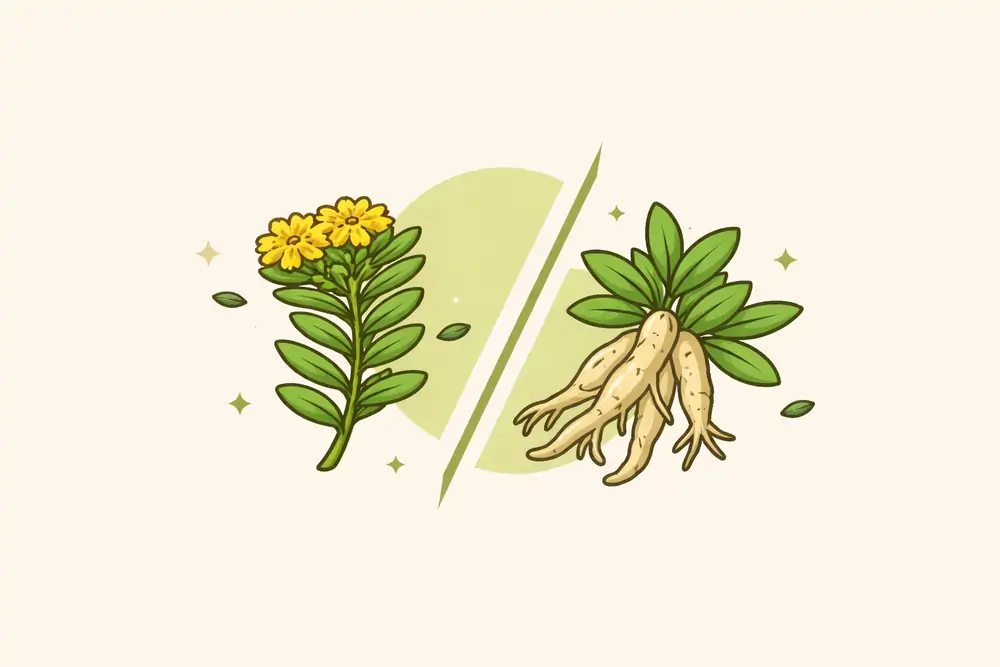
If you want the short version: rhodiola tends to be used for daytime “mental stamina” and perceived fatigue, while ashwagandha is more often used for calming, stress tension, and sleep support. That’s not a rule, but it matches how many people report the experience and how the clinical research clusters.
Both are discussed as adaptogens, yet “adaptogen” is a broad traditional concept. In modern research, the relevant question is narrower: which one has better human evidence for your main goal and better safety for your situation?
What are these herbs, exactly?
Rhodiola (Rhodiola rosea)
Rhodiola rosea is a cold-climate plant sometimes called “arctic root.” Most standardized supplements use the rhizome and root. Quality products often specify marker compounds such as rosavins and salidroside, because the Rhodiola genus has many species and not all match the research.
Ashwagandha (Withania somnifera)
Ashwagandha is an Ayurvedic herb also known as “winter cherry”. Supplements typically use root extract (sometimes root + leaf). Labels may mention withanolides as markers, but “withanolides %” alone does not guarantee clinical equivalence across brands.
What does the evidence say for stress and anxiety symptoms?
If your primary goal is stress tension or anxious feelings (not a medical diagnosis), ashwagandha has the more consistent human evidence. A 2024 meta-analysis (9 studies, 558 participants) reported statistically significant improvements in stress and anxiety measures and reductions in cortisol compared with placebo in the studied populations.
Rhodiola also appears in stress-related research, including regulatory monographs in Europe that recognize traditional use for stress-related fatigue and exhaustion. But overall, rhodiola studies often emphasize fatigue, cognitive performance under stress, and physical performance markers more than “calming.”
In a 2024 meta-analysis, ashwagandha showed significant improvements in perceived stress and anxiety outcomes across 9 trials (total N=558), with studied doses commonly in the 125–600 mg/day range for 30–90 days.
European regulators describe rhodiola root/rhizome preparations as a traditional herbal option for relief of stress symptoms such as fatigue and exhaustion (traditional use framework).
What does the evidence say for energy, fatigue, and performance?
If you’re comparing rhodiola vs ashwagandha for “energy,” define what you mean. Most people mean one of two things: (1) less perceived fatigue and more mental drive, or (2) better physical performance.
Rhodiola has newer meta-analytic work looking at performance outcomes and biomarkers in endurance contexts. That doesn’t mean it “boosts everyone,” but it shows why rhodiola is often positioned as the “daytime adaptogen.”
Ashwagandha is also studied for strength, recovery, and well-being, but its mainstream reputation is still more “calm + sleep.” If you’re already low-energy and stressed, the calming feel may help some people sleep better, which indirectly helps daytime function.
A 2025 meta-analysis evaluated randomized trials of Rhodiola rosea supplementation on endurance performance and physiological biomarkers, synthesizing evidence up to March 2025.
How do they work in the body (without overpromising)?
Mechanisms are not guarantees. Still, understanding the “direction” helps you choose.
Rhodiola: stress response + fatigue perception
Rhodiola research often discusses stress-response pathways, perceived exertion, and neurochemical signaling under strain. In practice, people usually take rhodiola earlier in the day because it can feel activating for some.
Ashwagandha: stress tension + sleep quality signals
Ashwagandha studies commonly measure stress scales and cortisol, and some trials measure sleep quality. Many users prefer evening dosing because it may feel settling. However, responses vary and some people feel groggy with higher doses.
Which one should a beginner choose?
Make the choice based on your primary use case, then confirm it with safety fit.
| Your main goal | Often a better first pick | Why | Common timing |
|---|---|---|---|
| Daytime fatigue, mental stamina, “burnout” feeling | Rhodiola | Traditional-use framework for stress fatigue; performance/fatigue research cluster | Morning / early afternoon |
| Stress tension, feeling “wired,” difficulty winding down | Ashwagandha | More consistent RCT/meta-analysis evidence for stress/anxiety symptoms | Evening or split dose |
| Sleep support (without making medical claims) | Ashwagandha | More trials include sleep-related outcomes | Evening |
| Performance-focused training block | It depends | Rhodiola has endurance-focused synthesis; ashwagandha has strength/well-being reviews | Goal-dependent |
What dose ranges show up most in research?
Don’t treat dose ranges like prescriptions. Use them to avoid unrealistic dosing and to spot products that look underdosed or overdosed.
Ashwagandha typical studied range
Many stress-focused trials use standardized extracts in the rough range of 125–600 mg/day for 30–90 days. Extract type matters, so compare “extract name/standardization,” not just milligrams.
Rhodiola typical studied range
Rhodiola trials vary widely by extract and outcome. Regulatory documents emphasize standardized preparations and appropriate product quality, and research often uses standardized extracts rather than raw powder.
Practical tip: for both herbs, a “start low, assess for a week, then adjust” approach is smarter than jumping to the highest capsule count.
What about side effects and interactions?
This is where rhodiola vs ashwagandha becomes very personal. “Natural” does not mean “interaction-free.”
Ashwagandha: key cautions
- Thyroid: Some reports and clinical discussions suggest possible thyroid hormone effects in certain people. If you have thyroid disease or take thyroid meds, be cautious.
- Pregnancy: Avoid unless a clinician explicitly advises otherwise.
- Sedatives / alcohol: May increase drowsiness in some people.
- GI effects: Upset stomach, nausea, or loose stools can happen.
- Liver concerns: There have been safety discussions and case reports in the broader literature; use reputable brands and stop if you develop symptoms like dark urine or jaundice and seek medical care.
Rhodiola: key cautions
- Too stimulating for some: Can feel jittery or disturb sleep if taken late.
- Medication interactions: If you take antidepressants or have bipolar disorder history, talk to a clinician first due to mood/activation concerns.
- GI effects: Nausea or stomach upset can occur.
If you are on prescription meds, pregnant, breastfeeding, or managing a chronic condition, check with a qualified clinician before starting either supplement.
How to pick a high-quality product
Two people can take “ashwagandha” and have totally different experiences because the products are not equivalent.
For rhodiola
- Look for Rhodiola rosea (not just “Rhodiola spp.”).
- Prefer labels that specify markers like rosavins and salidroside and disclose extract ratio.
- Choose brands with contaminant testing (heavy metals, microbes).
For ashwagandha
- Check whether it is root-only or root + leaf, and whether the extract is standardized.
- Prefer clear marker disclosure (withanolides) plus third-party testing.
- Be skeptical of extreme claims on labels or ads.
Checklist: a fast decision method
- Name one goal. “Less stress tension,” “better sleep,” or “less daytime fatigue.” Pick only one.
- Match herb to goal. Stress/sleep → often ashwagandha. Fatigue/drive → often rhodiola.
- Scan your risk flags. Thyroid issues, pregnancy, sedatives, mood disorder history, complex meds.
- Pick a standardized product. Clear markers + third-party testing beats vague labels.
- Start low and track. Sleep, energy, mood, GI comfort for 7–14 days.
- Stop if you get adverse effects. Don’t “push through” palpitations, severe anxiety, rash, or persistent GI issues.
Can you take rhodiola and ashwagandha together?
Some people combine them (rhodiola in the morning, ashwagandha in the evening). Conceptually, it’s a “day-night” stack. But stacking also stacks uncertainty: interactions, additive effects on mood/sedation, and product variability.
If you’re a beginner, I’d rather see you test one at a time for 2–3 weeks. That’s how you learn what actually works for you.
Where expectations go wrong
Most disappointment comes from one of these:
- Using the wrong tool: expecting rhodiola to fix insomnia or ashwagandha to create instant motivation.
- Undersleeping: no supplement replaces sleep debt.
- Overpromised outcomes: “adaptogens” support coping; they are not cures.
- Low-quality products: wrong species, low standardization, poor testing.
Rhodiola vs Ashwagandha | FAQ
Which is better for stress: rhodiola vs ashwagandha?
Ashwagandha has more consistent clinical evidence for stress and anxiety symptom measures in adults.
Which is better for energy and fatigue?
Rhodiola is more often used for perceived fatigue and daytime stamina; responses vary by person and product.
Can ashwagandha make you sleepy?
Yes. Some people feel more relaxed or drowsy, especially with higher doses or evening use.
Can rhodiola make you anxious?
It can feel stimulating for some people, especially if taken too late or at higher doses.
How long does it take to notice effects?
Many trials run 30–90 days for ashwagandha. For rhodiola, some people notice effects sooner, but research varies by outcome and extract.
Who should avoid these supplements?
Pregnant people, minors, and anyone with complex medical conditions or prescription medications should speak with a clinician first.
Glossary
- Rhodiola rosea: The studied rhodiola species most commonly used in supplements.
- Withania somnifera: The botanical name for ashwagandha (winter cherry).
- Adaptogen: A traditional term for herbs used to support stress resilience; not a guarantee of a specific medical outcome.
- Rosavins: Marker compounds often used to standardize Rhodiola rosea extracts.
- Salidroside: Another key rhodiola marker used in research and quality control.
- Withanolides: A class of compounds used to characterize ashwagandha extracts.
- Standardized extract: An extract adjusted to contain a consistent level of marker compounds.
- Third-party testing: Independent testing for identity and contaminants (e.g., heavy metals, microbes).
Conclusion
If you want calmer evenings and better stress balance, start with ashwagandha. If you want more daytime stamina under pressure, start with rhodiola—then let your tracking decide.
Sources used
- NIH Office of Dietary Supplements (ODS). “Ashwagandha—Health Professional Fact Sheet” (updated May 2, 2025). [oai_citation:0‡Office of Dietary Supplements](https://ods.od.nih.gov/factsheets/Ashwagandha-HealthProfessional/?utm_source=chatgpt.com)
- Arumugam V. et al. Systematic review/meta-analysis on ashwagandha effects on stress, anxiety, and cortisol (2024; 9 studies, 558 participants; doses commonly 125–600 mg/day for 30–90 days). [oai_citation:1‡ScienceDirect](https://www.sciencedirect.com/science/article/abs/pii/S1550830724001691?utm_source=chatgpt.com)
- European Medicines Agency (EMA), HMPC. EU herbal monograph: Rhodiola rosea L., rhizoma et radix (revision dated March 20, 2024) describing traditional use for stress symptoms such as fatigue/exhaustion. [oai_citation:2‡European Medicines Agency (EMA)](https://www.ema.europa.eu/en/documents/herbal-monograph/final-european-union-herbal-monograph-rhodiola-rosea-l-rhizoma-et-radix-revision-1_en.pdf?utm_source=chatgpt.com)
- EMA. “Rhodiolae roseae rhizoma et radix” overview page summarizing HMPC conclusions used by EU member states when evaluating herbal medicines. [oai_citation:3‡European Medicines Agency (EMA)](https://www.ema.europa.eu/en/medicines/herbal/rhodiolae-roseae-rhizoma-et-radix?utm_source=chatgpt.com)
- Tóth-Mészáros A. et al. Systematic review and meta-analysis on adaptogenic plants and stress outcomes (2023). [oai_citation:4‡ScienceDirect](https://www.sciencedirect.com/science/article/pii/S1756464623002955?utm_source=chatgpt.com)
- Wang X. et al. Meta-analysis on Rhodiola rosea supplementation and endurance performance/biomarkers (2025). [oai_citation:5‡PMC](https://pmc.ncbi.nlm.nih.gov/articles/PMC12507841/?utm_source=chatgpt.com)
- Health Canada. “Natural Health Product Monograph: Rhodiola—Rhodiola rosea” (Oct 31, 2025) providing regulatory-style guidance on acceptable labeling and conditions for product licensing. [oai_citation:6‡webprod.hc-sc.gc.ca](https://webprod.hc-sc.gc.ca/nhpid-bdipsn/dbImages/mono_rhodiola--rhodiola-rosea_english.pdf?utm_source=chatgpt.com)
- EMA. Withaniae somniferae radix (ashwagandha) herbal product page noting no adopted EU herbal monograph by HMPC (public info). [oai_citation:7‡European Medicines Agency (EMA)](https://www.ema.europa.eu/en/medicines/herbal/withaniae-somniferae-radix?utm_source=chatgpt.com)
- EMA. “List of references supporting the assessment of Withania somnifera (L.) Dunal, radix” (2013). [oai_citation:8‡European Medicines Agency (EMA)](https://www.ema.europa.eu/en/documents/herbal-references/final-list-references-supporting-assessment-withania-somnifera-l-dunal-radix-first-version_en.pdf?utm_source=chatgpt.com)


No comments:
Post a Comment